
Article: THE RAINBOW - MOLESWORTH LOOP - THE LONG ROAD
THE RAINBOW - MOLESWORTH LOOP - THE LONG ROAD
Blenheim to Hanmer Springs by the Rainbow Road and home through Molesworth
There are quicker ways to ride from Blenheim to Hanmer Springs. That was rather the point.
Instead of taking the main road south, Robin, known to most people as Goose, and I pointed two modest adventure bikes inland and made a two-day loop through the high country: Blenheim to St Arnaud, over the Rainbow Road to Hanmer Springs, then home through the vast, dry folds of Molesworth and down the Awatere Valley.
It is a journey of cold fingers, wet boots, loose rock, corrugations, creek crossings and long empty valleys. It is also one of the finest small-motorcycle adventures at the top of the South Island.
Cold hands and small engines
The first part was hardly heroic. We left Blenheim early and the cold found its way through my gloves before we were properly clear of town. By the time we were running west along the highway, my fingers felt frozen around the grips. Heated grips would have been a luxury worth every dollar that morning.
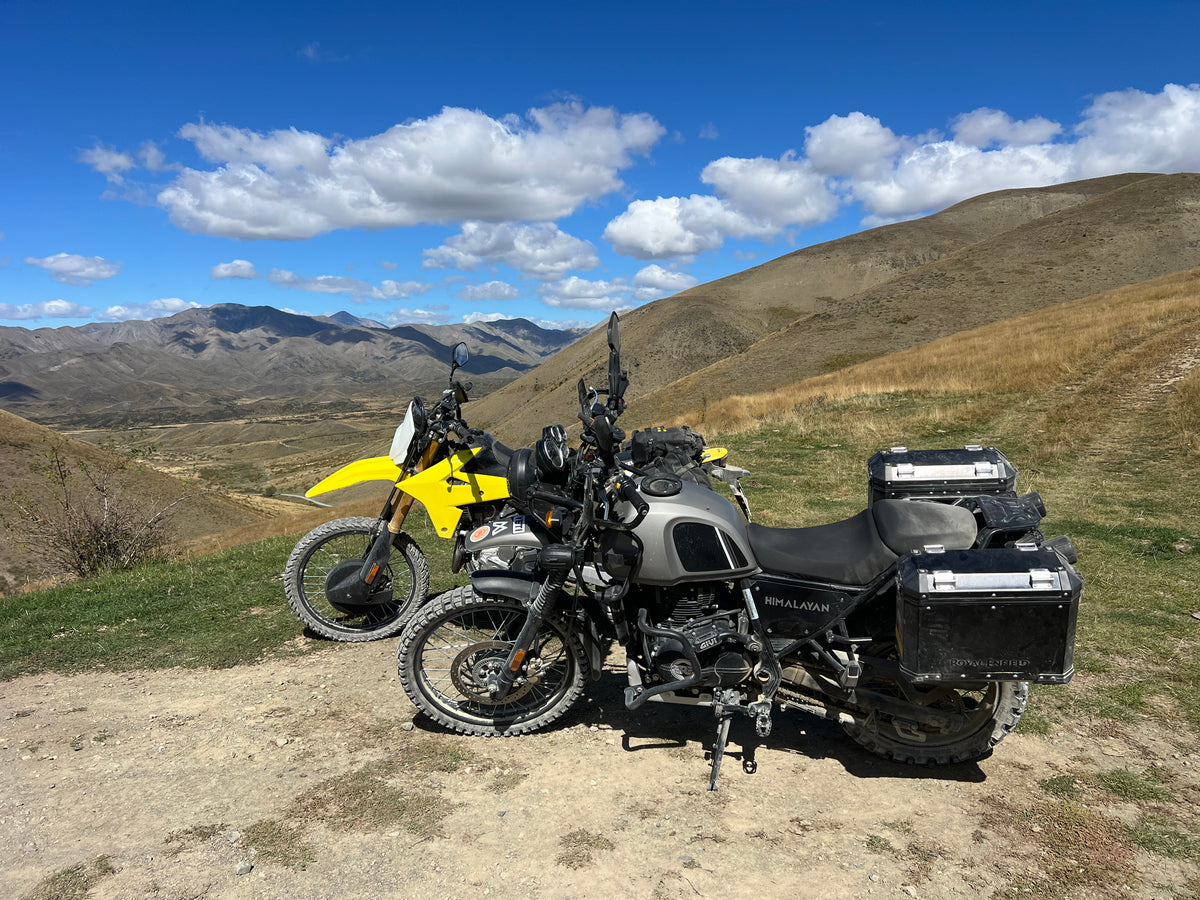
My bike was a 2021 Royal Enfield Himalayan: a 411 cc, long-stroke single with a five-speed gearbox and 32 Nm of torque. Standard, it produces only about 24.5 bhp. Mine is no longer standard. A new cam, freer-flowing exhaust, revised fuel system and air filter have helped the engine breathe and brought it closer to 28 horsepower. It is still not a high-powered adventure machine and makes even less sense if judged by motorway figures. But that misses the point of it. The Himalayan is low, steady and unhurried, with enough weight to feel planted and enough simplicity to invite roads that make shinier motorcycles nervous.
The engine work was only part of it. I had fitted upgraded rear suspension, wider handlebars, Barkbusters and Motoz Tractionator tyres, then loaded the bike with hard panniers and a top box for the trip. The wider bars gave me more leverage when the front wheel was knocked off line. The Barkbusters protected hands and levers from stones, branches and the inevitable low-speed mistake. The rear suspension mattered every time the loaded bike hit a pothole or a run of corrugations. None of the modifications turned the Himi into a superbike. They simply made it a more useful version of itself.
Goose was on his Suzuki DR-Z400, lighter and livelier but carrying less fuel. At St Arnaud he filled its little tank before we turned away from the ordinary road. That stop matters. Beyond St Arnaud there is no fuel, no shop, little or no mobile coverage and no quick recovery truck waiting around the corner.
He is the more experienced rider and the DR-Z is the faster bike, so Goose led for most of the trip. Our Cardo units kept us connected without stopping. His voice would arrive in my helmet with a warning about a deep pothole, loose rock, a rough entry into a crossing or a vehicle coming the other way. The warnings were useful; the rest of the commentary was less so. They regularly dissolved into laughter and the sort of expert advice friends reserve for one another: do not fall off, try missing the large rock, and yes, the water really is as cold as it looks. It made the long gravel stretches feel shorter and gave the whole ride the easy rhythm of two mates sharing the same road rather than simply following one another's dust.
Then the road changed, and so did the day.

Into the Rainbow
The Rainbow Road does not announce itself with grandeur. It simply becomes rougher. Seal gives way to gravel, gravel loosens into rock and the valleys begin to close around you. Power pylons march through the country, a reminder that the road was pushed through in the 1950s to service the electricity line supplying Nelson and Buller. Long before that, routes through these valleys were used by Maori travellers, and later by graziers shifting stock between Canterbury and Nelson and Marlborough.
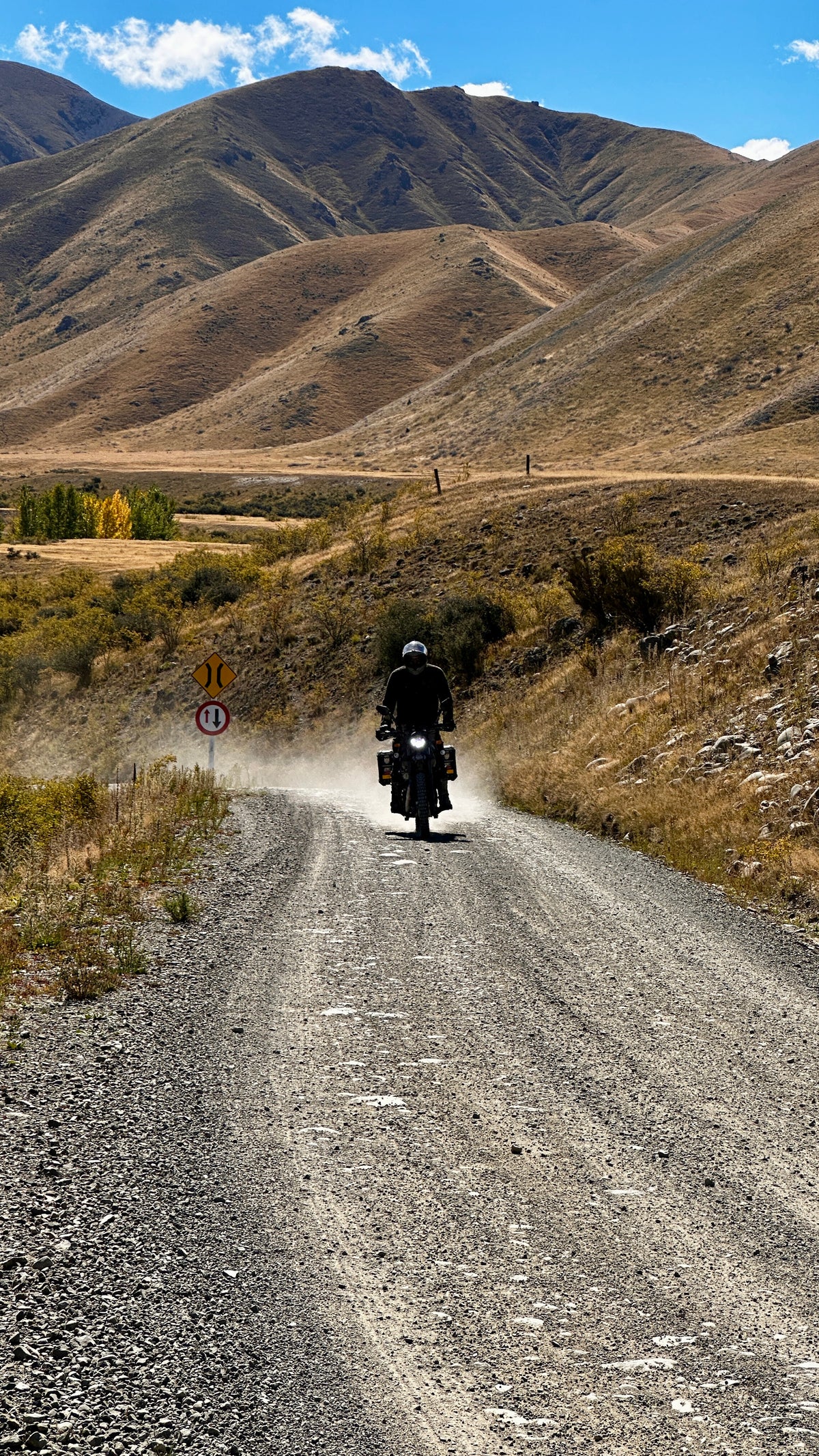
For a motorcycle, the road is a constant conversation. Stand on the pegs. Let the front wheel move. Pick a line through the stones. Sit for a moment. Stand again for the next set of corrugations. Swerve around a pothole only to meet another one beyond it. Goose picked the first line and called back what he found; I had the benefit of a few seconds' warning, but still had to ride it for myself. The Himalayan did not have the power to bully the track, so it had to work with it.
That is where the modifications stopped being a list of parts and began to earn their keep. The Motoz Tractionator tyres were a godsend. In loose gravel they found a line; on wet stones they gave the bike a chance to recover; and in the creek crossings they bit where a more road-biased tyre might have floated. We still had wheelspin - plenty of it - but it was the useful kind, the back wheel moving just enough to remind you that the surface was alive beneath you. The wider bars made those little corrections easier, while the upgraded rear suspension took the sharpest edge off the rocks and corrugations hammering through the loaded bike.
The crossings came one after another. Some were shallow sheets of clear water over rounded stone; others had enough depth and current to demand a proper look before committing. A wheel would strike a hidden rock, the bars would twitch, water would climb over the boots and a second later we would be out the other side with wet feet and the urge to laugh.
Between the crossings the road opened into sweeping gravel bends, then tightened again beneath beech forest. Sunlight flashed through the branches in hard bands of white and green, strobing across visor, road and handlebars. For a few seconds at a time it made the surface difficult to read: bright light, deep shade, bright light again. Then the trees would release us into open tussock country and the whole landscape would suddenly become enormous.
At the stops, the smaller life of the high country made itself known. Wasps were persistent, particularly around food and anything sweet, while enormous bumblebees moved heavily among the flowers, looking almost too big to remain airborne. They were comic until one passed close to an open visor.

The toll house and the usual photographs
Rainbow is not simply a public gravel road. Part of it crosses a working station and access is a privilege granted by the runholder. The toll booth is at the Old Accommodation House, roughly halfway through Rainbow Station. A motorcycle currently costs $30 and the payment is cash, so this is not the place to discover that every note is sitting safely at home in another jacket.
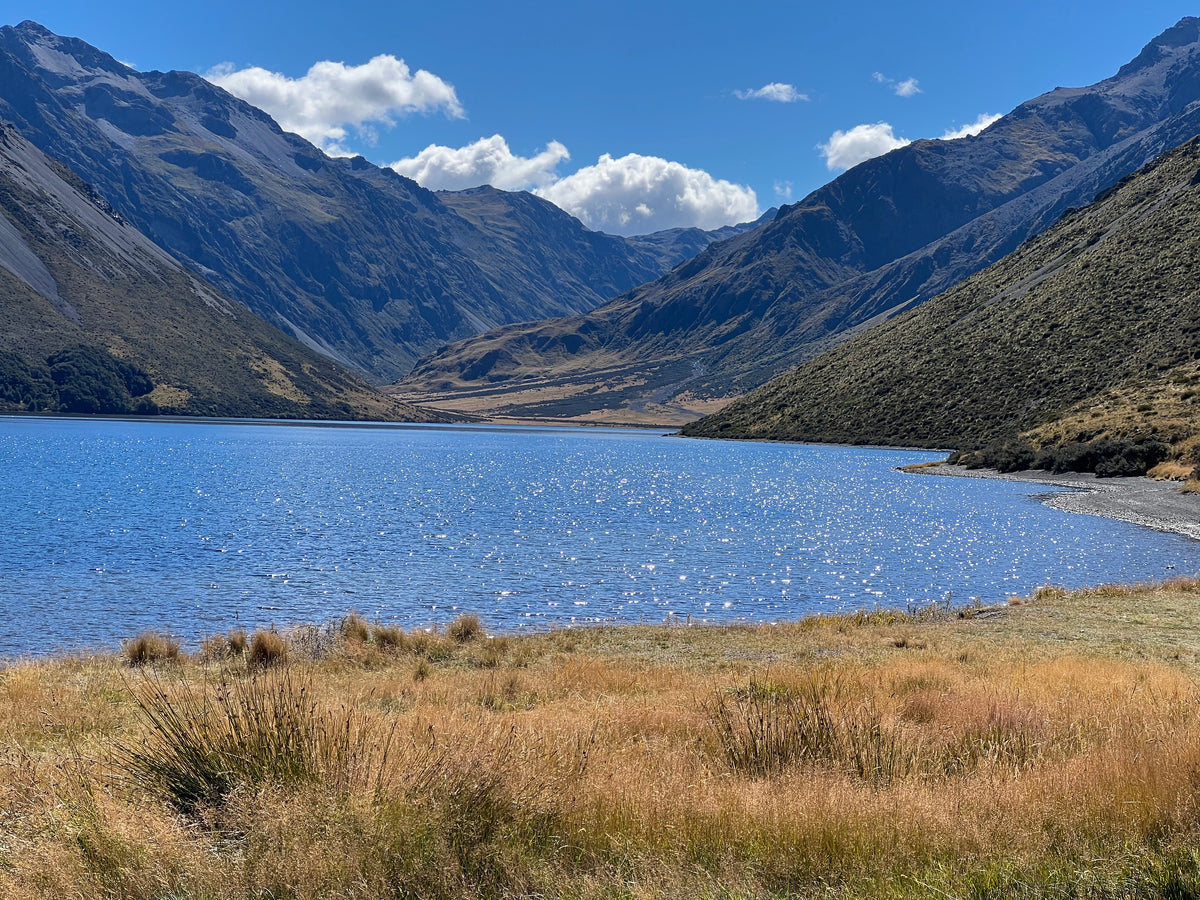
The road offers several places where even determined riders become tourists. Coldwater Creek marks the entrance to the tight country of Hell's Gate. The Sedgemere Lakes can be reached by a short walking detour, and in summer the surrounding gentians bring white into the tussock. Island Saddle, at 1,347 metres, sits on the watershed between the Wairau and Clarence rivers and is regarded as New Zealand's highest publicly accessible road. South of the saddle, Lake Tennyson lies behind a glacial moraine at the headwaters of the Clarence and makes an obvious place for photographs, lunch or a night under canvas.
There is no need to manufacture excitement on the Rainbow. It is built into the surface. Rock, washouts, loose gravel and blind bends arrive in their own time. We enjoyed the whole trip: standing for long stretches, letting the motorcycles move beneath us, dodging holes, clipping stones, spinning wheels and accepting that dry feet had ceased to be part of the plan.
Leaving the St James country behind, the road began to follow the Clarence and gradually dropped towards Hanmer Springs. The roughness eased, the corners lengthened and the valley drew us towards town. After hours of noise and vibration, ordinary streets felt strangely smooth.
Hot water and curry
We checked into the motel, dropped the gear and went straight to the thermal pools.
There are few better finishes to a day on a small adventure motorcycle. The heat worked its way into shoulders, forearms and hands that had spent the day absorbing the bars. Dust turned to clean water. Conversation slowed. The only work left was deciding which pool to move to next.
Curry followed - hot, uncomplicated and exactly right - then bed. No late-night heroics were required.
Conical Hill before breakfast
We were up early. Before getting back on the bikes, we ran eight kilometres from the motel, starting in the dark and climbing Conical Hill for sunrise, before returning as the village woke. The track rose through the forest above Hanmer, the air cold enough to clear the head and the first light arriving between the trunks.
It was a slightly perverse way to prepare for another full day in the saddle, but it changed the rhythm of the morning. By the time the engines started, the body was awake and the town had begun to feel too comfortable.
We climbed out over Jollies Pass, then veered right towards Molesworth.
The big country
If the Rainbow feels close, wet and technical, Molesworth feels open, dry and immense. The gravel is often faster but can be deeper, especially through corners and freshly worked sections. It invites speed while quietly punishing carelessness.
The road swept around hillsides and dropped towards the river in long, broad curves. On the modified Himalayan, roughly 28 horsepower was enough. The engine breathed more freely and picked up more willingly than the standard bike, while the new exhaust gave the long-stroke single a deeper note that rolled back from the valley walls. The pleasure still came from carrying momentum, reading the camber and letting the engine pull cleanly without rushing. This was adventure riding stripped of the arms race: two ordinary motorcycles, sensible speeds and a road far larger than either of them.
We stopped for lunch on the bank of the Clarence. The bikes clicked as they cooled. Water moved past the stones. Nothing about the meal needed to be elaborate; the place did the work.
Molesworth is New Zealand's largest active farm and a landscape shaped by ice, faulting, water, wind and hard use. Glacial moraines, outwash plains, hanging valleys and scree sit beside the evidence of generations of farming. The historic Acheron Accommodation House and Molesworth Cob Cottage belong to an older route through the country, when travellers, stockmen and gold-era traffic took days or weeks rather than hours. The Acheron house dates from 1863; the Cob Cottage followed in the 1860s, its earth-and-tussock walls making use of what this timber-poor landscape provided.
The country is not empty, though it can look that way at speed. Merino sheep and cattle occupy the working land. Banded dotterels and black-fronted terns breed around the braided Acheron system. Tussock, gentians and blue borage colour the flats in season, while the geology keeps showing through wherever the road or river has cut the surface open.
The Awatere always takes longer
Eventually we cleared the main Molesworth section and began the long run down the Awatere Valley Road. This is the part that catches people out. Reaching the end of Molesworth does not mean you are nearly home.
There is still a solid hour before the lower Awatere begins to feel settled, and the gravel continues for longer than memory suggests. Small sections of seal appear like promises, then vanish again. The road swoops and whoops downstream, following the valley through farm country. It is great riding, but by then every corrugation travels straight through the seat and every sharp stone comes up through the bars.
We took the Taylor Pass road back into the Wairau Valley and finally turned for home with sore backsides, tired hands and the particular satisfaction that comes from completing a proper loop rather than retracing the easy road.
Nothing about the journey required a 150-horsepower motorcycle. The Himalayan and the DR-Z were enough. More than enough, in fact. Their limitations kept us involved in the road rather than separated from it. We felt the cold, the crossings, the gravel, the rock and every bump on the way home.
That was the adventure.
Planning the Rainbow Road and Molesworth Motorcycle Loop
The access information below was checked on 21 September 2026. Both roads can close at short notice because of weather, flooding, fire danger or farming operations. Check the official road-status pages immediately before departure.
Route and realistic timing
Route snapshot
|
Leg |
Route |
Plan on |
|
Day one |
Blenheim - St Arnaud - Rainbow Road - Hanmer Springs |
About 220 km and a full day |
|
Day two |
Hanmer Springs - Molesworth - Awatere Valley - Blenheim |
About 207 km plus local detours |
|
Total |
Two-day high-country loop |
Roughly 425-440 km |
• Day one: Blenheim to St Arnaud on State Highway 63, then Rainbow Road to Hanmer Springs. Allow a full day. Rainbow Station advises about four hours from St Arnaud to Hanmer before sightseeing, creek inspections, photographs and breakdowns. The complete day is roughly 220 km, depending on where you begin and finish in Blenheim.
• Day two: Hanmer Springs through the Molesworth Acheron Road and down the Awatere Valley to Blenheim. DOC lists the complete Blenheim-Hanmer route as 207 km. Allow at least six to eight hours once stops and changing road conditions are included.
• Whole loop: Approximately 425-440 km before local detours. The kilometres are modest; the surfaces make them tiring.
Rainbow Road access toll and gates
• Rainbow Road normally opens for seasonal public access from Boxing Day. At the time of writing, the operator's road-status page states a 7 am Boxing Day opening, but the full 2026-27 closing date had not yet been published. Do not assume it is open just because it is summer.
• During seasonal access the gates operate from 7 am to 7 pm.
• The current toll is $30 cash per motorcycle, $60 cash per vehicle and $5 cash per bicycle or mountain bike. Walkers are not charged.
• Pay at the Old Accommodation House toll gate, approximately halfway through Rainbow Station. Carry cash.
• Outside the season, access must be requested from Rainbow Station and depends on farming, road and weather conditions.
• No hunting is permitted on Rainbow Station or along Rainbow Road while the road is open for seasonal access.
• The farmed valley floors are private land. Stay on the road, leave gates as you find them, respect stock and do not treat the route as open public country.
Molesworth Acheron Road access
• DOC states that Acheron Road opens from 1 October until Easter Monday or the second Monday in April, whichever is later, with daily access from 7 am to 7 pm.
• It can close without warning. Check DOC and the relevant Marlborough and Kaikoura road notices before leaving.
• Motorcycles and ordinary vehicles do not need an activity permit during the open season if they are not towing. Trailers require a permit; caravans, buses and vehicles over seven metres are not permitted.
• Keep to formed roads. Dogs are prohibited. Open fires are prohibited, including in the historic buildings.
Creek crossings and weather
Rainbow contains multiple unbridged stream and river crossings. Their depth can change quickly after rain, and cycle-route guidance warns that some can reach knee depth. Never assume the line used by the rider ahead is safe for your motorcycle.
Stop before a doubtful crossing. Look for current, depth, large submerged rocks and the exit line. If fast water is pushing stones along the bed, the sensible decision is to turn around. Wet boots are an inconvenience; a drowned bike or pinned rider in remote country is a rescue.
The route rises to 1,347 metres and can receive snow at any time of year. Carry insulating layers and proper waterproofs even on a fine summer morning. Heat, glare and dust can be equally severe in the open country. The station warns that strong winds, heavy rain and flooding can arrive quickly.
There is no reliable mobile coverage through Rainbow and little coverage across Molesworth. A personal locator beacon or satellite communicator is a sensible addition to a first-aid kit, tools, spare tube or repair kit, pump, drinking water and food.
Motorcycle set-up and fuel
This is not an ideal route for road tyres. A genuine adventure or dual-sport tread makes loose gravel, wet stones and deeper sections far more manageable. The Motoz Tractionators on the Himalayan were worth having, particularly in the crossings and looser corners.
The rest of the build also suited this route. The cam, exhaust, air filter and revised fuelling lifted the Himi from its standard 24.5 bhp to roughly 28 hp without changing its tractable character. Wider handlebars provided useful steering leverage on loose rock. Barkbusters protected hands and controls. Most importantly, the upgraded rear suspension coped better with corrugations, potholes and the weight of the hard panniers. These are not essential modifications for every rider, but each one had a clear job on this trip.
Check tyres, pressures, spokes, chain tension, brake pads, controls and wheel bearings before leaving. Secure luggage for repeated corrugations rather than for the sealed highway. Heated grips or quality winter gloves are valuable on the early run from Blenheim, even when the afternoon forecast looks warm.
Fuel is available in Blenheim, St Arnaud and Hanmer Springs, but there is none on Rainbow Road or through Molesworth and the Awatere back country. Fill at St Arnaud before Rainbow and fill again in Hanmer before the 207 km return to Blenheim. Riders with small standard tanks should calculate real gravel range, include a reserve and carry approved extra fuel if required.
There are no shops between the towns. Carry lunch, snacks and enough water. Water taken from streams or rivers should be boiled, filtered or treated.
The best stops on Rainbow Road
• Coldwater Creek and Hell's Gate: A useful pause before the road enters the narrow gorge. Check conditions through this section carefully after rain.
• Sedgemere Lakes: A short walking or cycling detour gives views over the high-country lakes. Summer gentians are a feature.
• Island Saddle: The high point at 1,347 metres, on the watershed between the Wairau and Clarence rivers. Expect wind and rapidly changing conditions.
• Lake Tennyson: A glacially formed lake and popular picnic, fishing and camping stop near the Clarence headwaters.
• St James and Clarence viewpoints: The southern descent gives broad views into the St James and upper Clarence country before the road drops towards Hanmer.
The best stops through Molesworth
• Acheron Accommodation House: An 1863 cob building once used as an overnight carriage stop. It is also a DOC campsite.
• Pig Trough Suspension Bridge and shelter: One of the surviving electricity-department bridges, with a toilet, shelter and interpretation panels.
• Severn Rock Shelter: A practical weather stop with a toilet and displays about packmen, stockmen and musterers.
• Isolated Flat: A 250-hectare glacial outwash plain bounded by the Awatere Fault, with gentians and blue borage in season.
• Wards Pass: At 1,145 metres, this is the high point of Acheron Road and can be affected by snow.
• Molesworth Cob Cottage: The historic gateway at the northern end of the station and a good place to understand the farming and travel history of the route.
• Hodder Bridge Picnic Area: A useful toilet and picnic stop farther down the Awatere Valley.
Camping options
Rainbow Station permits camping only at the recognised DOC huts and campsites identified by the station: Connors Creek Hut, Coldwater Creek Campsite, Sedgemere Sleepout, Island Gully Hut and Lake Tennyson. Check the status, facilities, fees and booking requirements for the individual site before relying on it. No outdoor fires are permitted.
On Molesworth Station, independent camping is limited to Acheron Accommodation House Campsite and Molesworth Cob Cottage Campsite. DOC currently lists both at $10 per adult and $5 per child per night, with advance booking required. Camping is also available before the station at Blairich Recreation Reserve. Do not freedom-camp elsewhere on the working station.
Where to stay in Hanmer Springs
• The St James: A comfortable five-star option just off the main street, about a three-minute walk from the thermal pools, cafes and shops. A good choice when the aim is to park the bike and walk for the rest of the evening.
• Hanmer Springs TOP 10 Holiday Park: Cabins, motel units, self-contained accommodation and tent or powered sites, about five minutes' walk from the village. This is the flexible choice for riders carrying camping gear or travelling as a group.
• Spa Lodge Motel: Straightforward self-contained motel accommodation in a garden setting, within walking distance of the pools, restaurants and village. A practical base for one night and an early start.
Ask any accommodation provider about motorcycle parking when booking, rather than assuming covered or secured parking is available.
Three places to eat
• India Springs: A natural choice after a cold, wet day - North Indian and Indo-Chinese dishes, with dine-in and takeaway in the village.
• Powerhouse Cafe: Breakfast, coffee or an early lunch in Hanmer's old powerhouse building. Its current published hours are 7.30 am to 2 pm daily, subject to change.
• MK Restaurant: A more deliberate evening meal, known for food made from scratch and a menu built around dumplings and filled pastries from several traditions. Check the opening days and book ahead.
Spice Village is another dependable curry option. Restaurant hours change seasonally, so confirm them before arriving late.
Other ways to do the route
By 4WD: Rainbow Station and DOC recommend a high-clearance 4WD or capable AWD for Rainbow. The road is narrow in places, with blind corners and hazards that may not be marked. Check insurance cover for private, unmaintained roads. Molesworth's Acheron Road is officially suitable for two-wheel-drive cars in good conditions, but it remains a long, corrugated and exposed high-country road; a suitable high-clearance vehicle gives a wider safety margin.
By bicycle: The Rainbow Trail is a Grade 3-4, 115 km heartland ride normally completed in two to three days. The Molesworth Muster Trail is a Grade 4, 207 km ride usually allowed three to five days. Both require fitness, self-sufficiency and careful planning. There are no shops or charging points between the towns, and e-bike riders must plan battery range accordingly.
As a longer motorcycle trip: Add a night at Lake Tennyson, Acheron Accommodation House or Cob Cottage; link the route with the St James area; or continue from St Arnaud into Nelson Lakes. The Severn-to-Sedgemere road is a separate 4WD-only side route with a much shorter open season and should never be assumed available to motorcycles.
Final cautions
• Check Rainbow Station road status, DOC's Acheron Road status, weather and council road notices on the morning of travel.
• Tell someone your route and expected check-in time.
• Carry cash for Rainbow's toll.
• Fill up in St Arnaud and Hanmer.
• Expect oncoming vehicles, stock and cyclists around blind bends. Keep left.
• Do not chase speed on loose gravel. Deeper gravel can pull the front wheel without warning.
• Treat every creek crossing as a fresh decision.
• Allow daylight in reserve. The gates have closing times and the valleys darken early.
• Leave gates as you find them, carry rubbish out and keep off private farm tracks.
The loop rewards preparation, but it does not demand an expensive motorcycle. A sound small-capacity bike, suitable tyres and a rider willing to slow down are enough. That is part of its appeal: the Rainbow and Molesworth make the adventure. The motorcycle simply gets you into it.
Official planning links
• Rainbow Station road access and status: https://www.rainbowstation.co.nz/get-access and https://www.rainbowstation.co.nz/road-status
• Rainbow Station tolls and trip advice: https://www.rainbowstation.co.nz/toll-charges and https://www.rainbowstation.co.nz/plan-your-trip
• DOC Rainbow Road: https://www.doc.govt.nz/parks-and-recreation/places-to-go/marlborough/places/molesworth-reserve/things-to-do/tracks/rainbow-road-hanmer-springs-to-st-arnaud/
• DOC Acheron Road: https://www.doc.govt.nz/parks-and-recreation/places-to-go/marlborough/places/molesworth-reserve/things-to-do/tracks/acheron-road/
• Hanmer Springs Thermal Pools: https://hanmersprings.co.nz/
• Hanmer Springs visitor information: https://visithanmersprings.co.nz/






Leave a comment
This site is protected by hCaptcha and the hCaptcha Privacy Policy and Terms of Service apply.