
THIS IS AFRICA | AN HONEST HUNT IN THE EASTERN CAPE
Pull up a chair. The fire's warm, and you're in good company.
A few years ago, I was invited to the Eastern Cape of South Africa to take part in a wild-game hunt.
I jumped at the chance.
There will be people, probably not our typical followers, who read the word hunt and immediately reach for the usual accusations.
How cruel.
You murderer.
They are entitled to their opinion, but they would be missing the point.
This was a managed cull in the country surrounding Queenstown, where farming and wildlife meet and frequently clash. The land had been without an effective population of large natural predators for more than 300 years. Without predators capable of regulating the great herds of wild herbivores, that responsibility had fallen to man.
There is no easy or romantic way to describe it. Animal numbers must be counted, the carrying capacity of the land calculated and the excess removed. Without systematic culling, populations grow beyond what the ground can sustain. The veld is stripped, food becomes scarce and every species eventually suffers.
This was conservation through management, conducted for the benefit of the wildlife, the farmers and the local tribespeople who all depended upon the same land.
Conservation is not only about protecting animals. Sometimes it is about making difficult decisions. Sometimes it requires killing them.

Into the Eastern Cape
We stayed at Thaba Thala Safaris, near the small farming village of Sterkstroom. There were five of us: four friends from the United Kingdom and me, travelling from New Zealand.
We met at Johannesburg Airport, flew down to East London and then transferred inland to Sterkstroom, roughly two hours to the north.
The afternoon continued much as the morning had begun. By the time the sky mellowed, softening through the spectrum into the drama of a kaleidoscopic sunset beyond the lodge and the distant plateau, we were thoroughly drunk.
It was very good to see these fine friends once again.
The country around Thaba Thala was immense. Dry, straw-coloured grasslands stretched between broken ridges and flat-topped plateaux. Green belts of thorn trees followed the gullies and watercourses, while prickly pear and low scrub clung to the harder ground.
In places, centuries of water had cut deep dongas through the iron-red earth, sculpting the soil into pillars, buttresses and miniature ravines. Elsewhere, the land opened into broad plains with mountains rising beyond them in long, level walls.
White wind turbines turned slowly along the distant skyline. They appeared almost impossibly modern against a landscape that felt ancient.
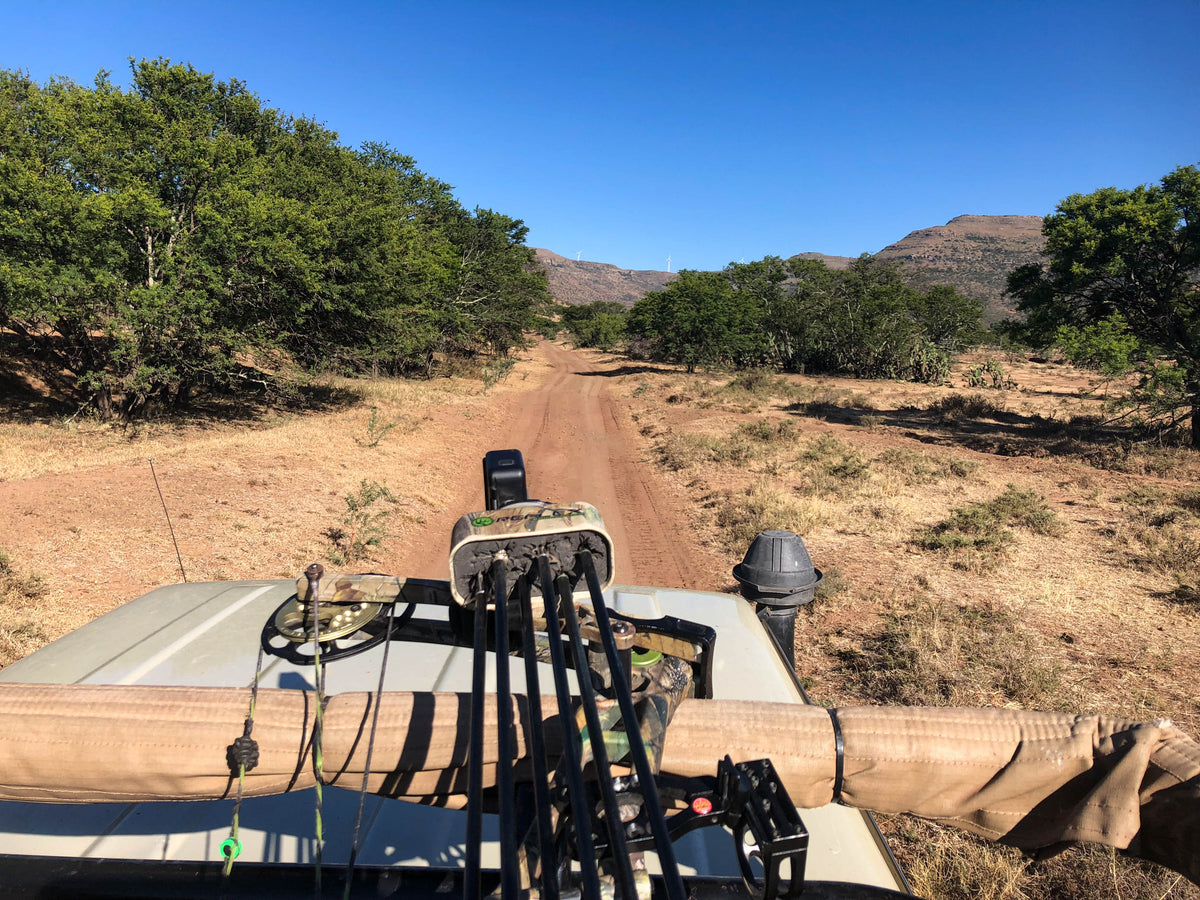
The safari vehicles were purpose-built Toyota Land Cruisers with bull bars, snorkels and elevated seats above the open rear deck. From those high seats, the trackers could scan the veld while rifles, bows and shooting sticks travelled secured below.
They were proper working vehicles, dusty, battered and perfectly suited to the country.

A Bow in Rifle Country
I had brought my compound bow, while the others would be hunting with rifles.
Strangely enough, getting my bow through customs proved considerably more difficult than getting the firearms through. The guns appeared to be understood. The compound bow, with its cams, cables, carbon arrows and mechanical broadheads, attracted rather more suspicion.
We had the entire lodge to ourselves. Our professional hunter was Bruce, a true legend and the sort of man whose quiet competence told you immediately that you were in capable hands.
The plan was to divide into groups of two.
There were five of us, which did not add up particularly well. As the only bowhunter, I headed out with my tracker, Sammi.
The others drove farther into the bush in search of game. Sammi and I went on foot.
We walked and stalked.
That is the essential difference with a bow. A rifle permits distance. A bow demands that you enter the animal’s world. You must understand the wind, read the ground and use every gully, bush and fold in the land. At close range, the smallest mistake is enough. A snapped twig, a sudden movement or an eddy of human scent can end the hunt before the bow is ever drawn.
The first game animals we spotted were impala. A small herd stood approximately 120 metres away, and among them was a large ram.
I singled him out, and we began our approach.
We used the scrub and gullies as cover, staying low and downwind as we gradually closed the distance. Every movement had to be deliberate. When the impala looked in our direction, we froze. When their heads went down again, we moved.
Eventually, a thorn bush provided the cover I needed for the final approach.
The herd was now approximately thirty metres away.
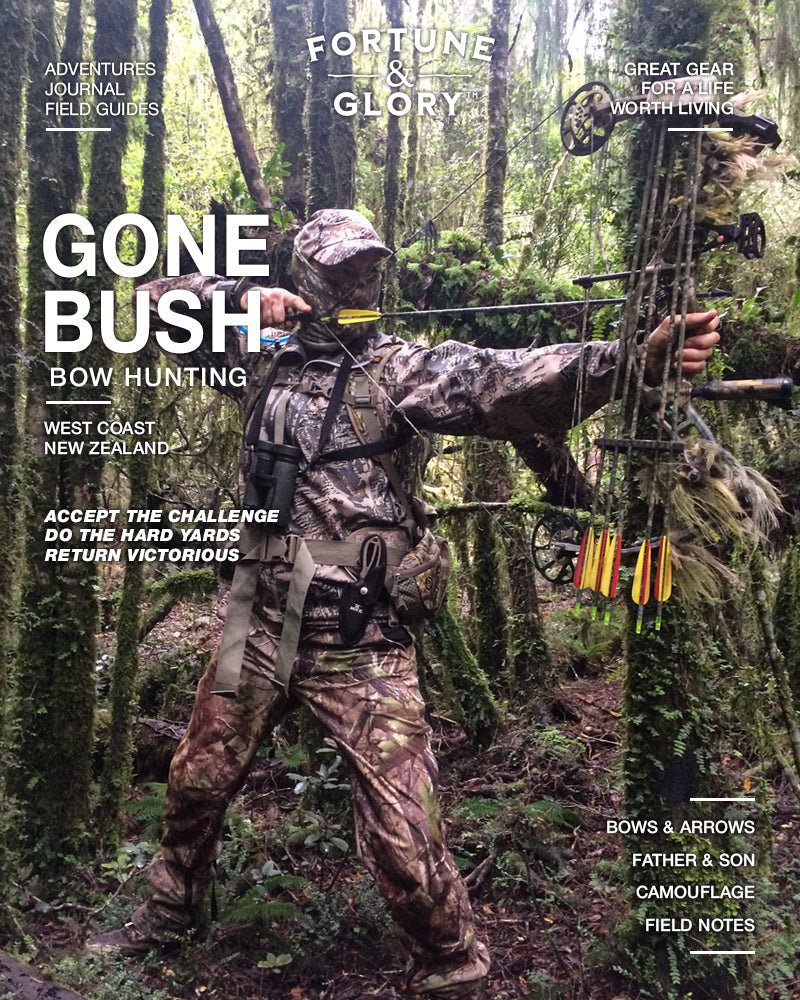
Behind the bush, I nocked an arrow tipped with a mechanical broadhead. I raised the bow into position and drew the string carefully back until the fletching gently kissed my cheek.
Then I waited.
The wind held. It was a gentle but persistent breeze coming directly out of the north, exactly as we had planned. My Multi-Cam leaf-cut jacket broke up the distinctive outline of the human body. The impala remained completely unaware of my presence.
Slowly, I stepped out from behind the thorn bush.
The ram stood broadside.
I took several calming breaths, settled the sight just behind his shoulder and loosed the arrow.
The shaft sprang from the bow and sailed towards the impala’s chest. I followed its trajectory all the way to the animal.
It struck home just behind the shoulder blade, passing through the ribs and into the lungs.
The impala ran.
I stayed still.
There was no shouting and no immediate pursuit to drive fear through the herd. With no sign of a predator following him, the ram did not travel far. He slowed, lay down and quietly expelled his final breath.
Sammi gently tapped me on the back in congratulations.
There was no yeehah. There was no high five and no theatrical celebration of the animal’s death.
There was simply a quiet acknowledgement of a clean shot and a moment of respect for the life that had just been taken.
This was proper hunting: the animal respected and the process honest.

The Warthog at the Watering Hole
Later that day, we found a family of warthogs beside a watering hole.
It was not the blue African oasis imagined by travel brochures. The water was shallow and muddy, coloured reddish brown by the iron-rich earth. Around it, the exposed shoreline had dried and cracked beneath the November sun.
The mud was littered with spoor.
Large cloven hoofprints had been driven deeply into the soft ground beside smaller, sharper antelope tracks. Warthog slots crossed and recrossed the margin. Bird prints ran between them. Some tracks remained sharply defined while others had been trampled almost beyond recognition.
It was a record of the animals that came there to drink: wildebeest, kudu, antelope, warthogs and countless smaller creatures, all drawn to the same diminishing patch of water.
The warthogs were grubbing around the muddy shore, turning over the soft ground with their snouts in search of roots and anything else worth eating.
By then, the conditions had changed. The midday sun had warmed the dry earth, and the steady morning breeze had become fickle. Heated currents rose from the basin, carrying dust and scent into small, unpredictable vortices that twisted between the thorn trees.
For a bowhunter attempting to approach within thirty metres, it was far from ideal. The wind might favour us one moment and betray us the next.
But this was a once-in-a-lifetime opportunity, and such opportunities seldom arrive under perfect conditions. It would call for persistence and resilience.
We used everything the country offered. We slipped behind sweet-thorn trees, moved through clumps of karee and followed the deeply eroded edge of a donga towards the water.
The warthogs made the approach considerably more difficult than the impala had. They were never still, not even for a second. They grubbed through the mud, shuffled forward and changed direction without warning.
Every time we closed the distance, they moved again.
Eventually, I found an opportunity and drew the bow.
As I settled into my anchor, the warthogs began moving slowly into light cover. Branches and scrub broke up the target.
I held at full draw, waiting for the animal to step clear.
It did not.
The likelihood of seeing the hogs again was disappearing with them. I judged that there was enough of the target visible, fixed the sight upon it and let the arrow fly.
The resultant squeal was enough to tell us that the arrow had struck.
Unlike the impala, which had remained calm and unaware of any pursuit, the squealing warthog sent panic through the entire sounder like wildfire.
They scattered in every direction.
Hooves struck the hard earth. Dust rose around the watering hole. The hogs regrouped briefly beyond the trees and then vanished into the bush.
They were not seen again.
The blood trail was faint, but it was visible. Sammi and I followed it away from the churned mud and across the dry ground for several hundred metres before losing it at the base of a scrub-covered kopje.
We searched frantically. More local trackers were brought in, and together we worked around the kopje, looking beneath bushes, examining tracks and searching for the smallest spot of blood.
Nothing.
The warthog had performed a Houdini.
Eventually, we had to accept that we were not going to find it. The disappointment was considerable. A warthog would have made a great trophy, and after coming so close, returning without it was a bitter end to the stalk.
Not every shot results in a clean kill. That is the truth of hunting.
Animals move. Winds change. Branches deflect arrows, and judgements made in a fraction of a second do not always produce the outcome the hunter intended. No responsible hunter sets out to wound an animal, but pretending that it never happens would be dishonest.
When it does happen, the responsibility is to track it, search for it and do everything possible to recover it.
That is what we did.
Sometimes, despite everyone’s best efforts, the animal is not found.

The Boma
We cut our losses and headed back to the boma for pre-dinner refreshments.
The boma stood high upon a rocky shelf overlooking the immense valley and distant plateaux. A great stone fireplace had been built into one side, with an open hearth large enough to swallow whole branches. Canvas chairs were arranged outside, facing the view.
The first cold Castle lagers appeared while the sun was still hanging above the mountains.
The serious drinking began once the rifles were locked away.
Several bottles of Amarula Cream did not last long. When in Africa, one must drink Amarula.
The crew regaled one another with stories from the first day: difficult stalks, long shots, good tracking and the game that had escaped. The stories grew steadily more adventurous as the bottles emptied.
It was tremendous fun.
This was the stuff of legend: rugged gentlemen, the greatest of friends and a hunting camp in Africa.
To be clear, this was a herbivore-management cull. No large predators were being hunted. The only other animals on the control list were jackals and baboons, thieving, murderous swine that genuinely affected the livelihoods of the farmers and tribespeople.
The jackals killed livestock. The baboons pillaged crops. Between them, they could destroy the food and income upon which entire families depended.
It was not an abstract argument when you lived on that land.

Thirty-Five Blue Gnu
The following morning, I exchanged the bow for a rifle.
The cull was about to increase considerably in scale. We had been tasked with taking wildebeest for the entire day.
The blue wildebeest, or blue gnu, is a formidable animal. Without large predators controlling their numbers, they form immense herds capable of placing enormous pressure upon the grasslands.
Our tally was seven wildebeest each.
There were five of us, making thirty-five animals in total.
That number had not been invented for our entertainment. It was the removal figure calculated for herd control at the end of the hunting season in November. It was the number considered necessary to retain a workable ecological balance between the species living on the property.
The herd before us was impressive. There were at least two hundred animals grazing across the veld like supercharged lawnmowers. They advanced systematically, chewing the grasses down to the bare earth and leaving little standing feed for the smaller and less prolific species behind them.
We positioned ourselves in a broad U ahead of the advancing column. Our fields of fire were established, the instructions made clear and the rifles readied.
When the signal came, we began.
It was an extraordinary scene from a shooting perspective, although unlike any hunting we had experienced before. There was no stalking an individual animal over the course of a day. This was an organised cull conducted at scale.
The only thing that came remotely close was pigeon shooting over the stubble fields of Suffolk.
By the end of the day, the tally had been completed.
The dressed carcass weight was close to five tonnes. Five tonnes of premium protein destined for high-end restaurants and the local tribespeople, who particularly prized the tripe and organs.
Nothing was wasted.
Every animal had been taken for a calculated reason. Every carcass was recovered, processed and used.
That evening, the Amarula had been replenished.
We began with that again, poured chilled over ice as the last of the sun warmed our satisfied souls.
Each night, we ate from the day’s bag. That evening, we had the choicest cuts of wildebeest: backstraps, steaks, liver and tongue.
There were no testicles, despite what some might consider an African delicacy.
The great stone hearth glowed against the fading light. Later, a bonfire of whole branches rose into the darkness, throwing sparks above the thorn trees.
The stories from the years we had spent apart fuelled the conversation late into the night. Above us, the stars spread wide and bright across the southern sky.
Africa.
There really is no place like it.
The sense of belonging is deep, visceral and entirely tangible. You can feel that this is the continent upon which our earliest ancestors first walked upright, made tools and mastered fire.
You feel it in the dust, the darkness and the flames.
TIA.
This Is Africa.

Ten Metres from Kudu
We were dressed and ready well before first light on the third day.
We had returned to individual hunting, so I teamed up with Sammi once again and took the compound bow.
We drove for approximately thirty minutes towards the back of the property in one of the open-backed Land Cruisers. The bow rode secured across the vehicle as the truck climbed over the rough tracks between the hills.
The plan was to hunt our way back towards the lodge with the wind in our favour.
Once the engine had died and the bush was silent again, we set off at an oblique angle, roughly back in the direction from which we had come.
We had the entire day to walk and hunt the distance that had taken the Land Cruiser thirty minutes to cover.
I reckoned it was about ten kilometres.
The November rains had not yet arrived, and the ground was parched. The smallest twigs snapped and crackled beneath my boots.
I lowered my pack and removed an extra-large pair of socks. Pulling them over my boots, I used an old Rhodesian Special Forces trick to soften and mute my footfalls.
It did the job.
We hunted through the bush, seeing game both near and far. Some species were on the cull list. Others were not.
The highlight came an hour or so into the hunt.
In a clearing approximately one hundred metres away stood two enormous kudu bulls. Their long necks were stretched upwards as they browsed the new leaves and small fruit of a karee tree.
They were gorging themselves and had not seen us.
We watched them for an age.
I knew they were not on the cull list. Taking one would cost me an additional US$1,000.
I was mighty tempted.
They were magnificent animals, heavy through the neck and shoulders, with great spiralling horns rising above their heads.
We began to stalk them.
Whenever the kudu moved, we moved. We never allowed them to gain distance. Slowly, using the wind and cover, we began to close the gap.
After several hours, we had worked our way to within forty metres.
The wind remained true.
We continued manoeuvring, crawling and detouring so that we remained downwind. Every metre took patience. Every movement had to be made when both bulls were feeding or looking away.
An hour later, we were ten metres from them.
They may have been brothers. Their markings and stature were remarkably similar.
They still had no idea that we had been watching and following them for nearly three hours.
I nocked an arrow, just in case.
A thousand-dollar arrow.
That would make for an expensive day.
We closed the gap still further. The arrow remained nocked, but I did not draw the bow.
The time spent so close to those magnificent wild animals was one of the most extraordinary wildlife experiences I had ever encountered. We were separated only by a small mound and a thin screen of bush.
The kudu continued reaching upwards. Their long, thick tongues rolled around the tender shoots and spring leaves before pulling them into their mouths.
I could hear them breathing.
I could hear their teeth grinding and the heavy movement of their stomachs. I could see flies crawling around their eyes and watch their long lashes flick them away. The insects would circle briefly and then settle again, searching for moisture.
The shot was there.
Still, I could not draw the bow.
For once, being close was enough.
Then the wind changed.
Both bulls caught our scent.
Their heads turned towards us in perfect unison. They stared for a second, trying to understand what had appeared so close to them.
Then they vanished.
With one great leap, they were gone, swallowed by the bush. I heard them crashing through the scrub for a few fleeting seconds.
Then there was silence.
Only then did I let out the breath I had been holding.

Poachers in the Bush
Not long after the kudu disappeared, the hunt was interrupted.
There were poachers on the property.
The news moved quickly among the guides and trackers, and the wildlife hunt was put aside while we attempted to find them. These were not paying hunters working to an agreed cull figure. They were trespassers taking animals without permission, quotas or accountability.
We followed the available signs and attempted to intercept them, but they knew they had been discovered and slipped away through the bush.
They escaped us that day.
The police caught up with them later.
With the immediate search over, Sammi and I resumed the long hunt back towards the lodge.
Nothing could quite compare with the kudu encounter, but the country remained alive with game. We saw roan and sable antelope, both great mature bulls standing alone and appearing to own every inch of the land they surveyed.
Ostrich, springbok, waterbuck, black wildebeest, klipspringer, gemsbok, red hartebeest and a surprising number of fallow deer crossed our path.
Most remained beyond bow range.
That day, however, the bow remained silent.

The Greatest Kitchen in Africa
There was no shortage of fresh protein at the lodge.
The others had provided impala, gemsbok, waterbuck, springbok and the mighty eland. Soon, great quantities of meat were sizzling over the braai.
There was no room for anything green or beige.
Just meat.
The way it should be.
The South African braai must be one of the greatest kitchens in the world. There is nothing complicated about it: open fire, hot coals, flame-grilled meat and smoke rising into the evening air.
Natural and delicious.
The meat was tender, with every species carrying a different degree and character of gaminess. The eland liver and kidneys were something of an acquired taste, but TIA, so we tried everything.
Nothing was wasted.
The meat was washed down with local wines: rich red Shiraz and refined Pinotage. After that came more ice-cold Amarula and Scotch whisky.
The hangover began well before bed.
Such is the excitement of a once-in-a-lifetime adventure that it had mostly disappeared by breakfast.
The bacon and eggs helped, as did a hair of the dog or two.
TIA.

The Springbok Cull
On the fourth day, I found myself behind a rifle again.
This time, springbok were the quarry.
They were another prolific species whose numbers had exceeded the level set for the property. Out on the open veld east of the Drakensberg, they had gathered into an enormous herd.
There were approximately four hundred of them.
The trackers began pushing the herd towards us. From a distance, it looked as though the exercise might be like shooting ducks in an alley.
We soon discovered otherwise.
Springbok appear to possess an uncanny ability to sense impending doom. The herd began hopping, leaping and changing direction. Animals sprang vertically into the air, landed and immediately darted elsewhere.
There was no discernible pattern to it.
Small in stature but enormous in heart, they proved difficult targets. The shooting required concentration and timing.
Eventually, the call came to unload.
Nearly fifty springbok lay across the veld.
Once again, there would be no shortage of protein that evening, either for the hunters or for the hundreds of villagers associated with the lodge and safari operation.
Close to a tonne of fine, delicate springbok meat was processed and shared.
There were smiles everywhere.

The Rest of the Bag
As the safari continued, I moved between the bow and rifle according to the animal, the ground and the work required that day.
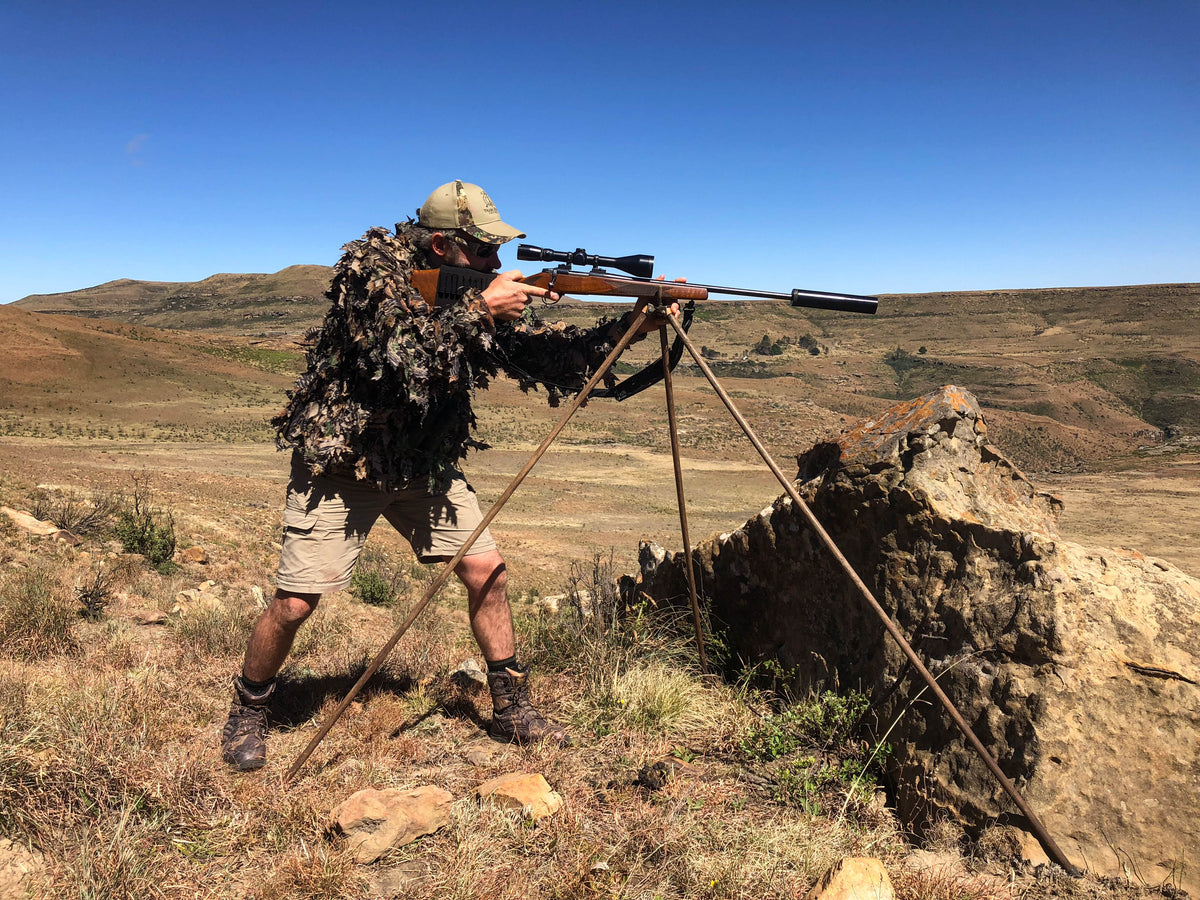
With the bow, I took a springbok out on the dry, golden grassland. My leaf-cut camouflage almost disappeared against the brittle veld, although the orange fletching in the bow-mounted quiver most certainly did not.
There were black wildebeest too, including one taken with the bow on a high, windswept slope. Its dark hide lay against the pale grass with the plateau country falling away behind it.
Another black wildebeest was taken with the rifle.
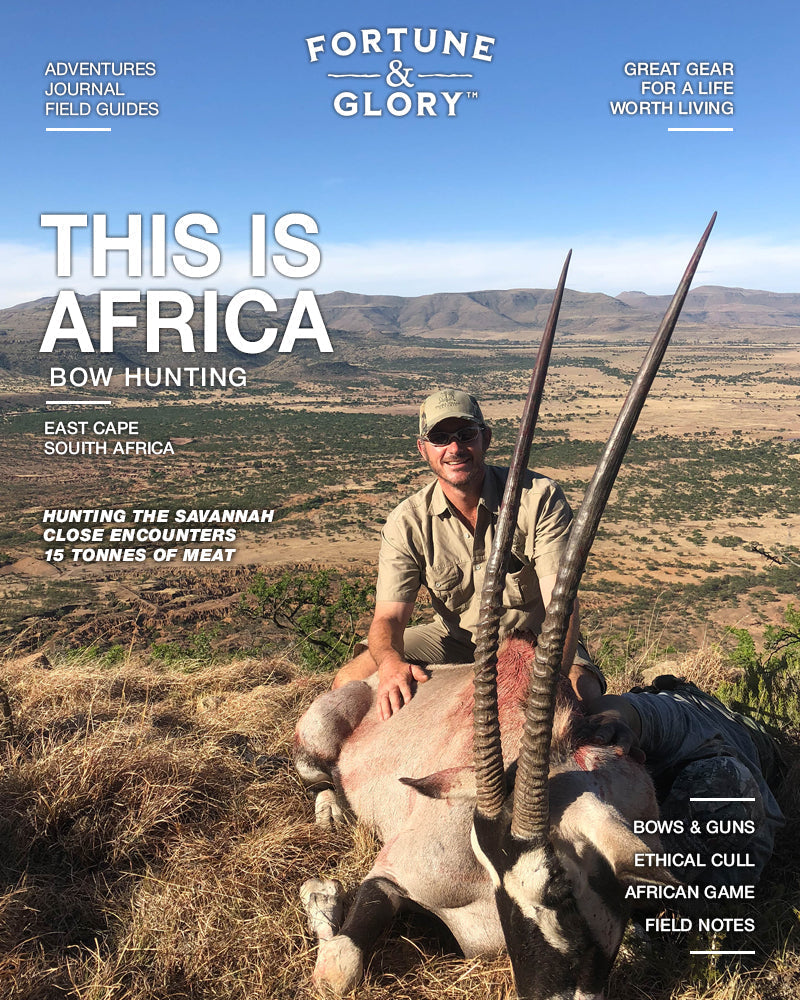
There was a gemsbok upon the higher ground, its extraordinary spear-like horns rising against the distant ridges. It was a magnificent animal in magnificent country, taken where the open mountains and dry plain seemed to continue forever.
A red hartebeest fell among the thorn trees and iron-red soil. Its heavy, sharply angled horns curved forward above a long face, and its tawny hide carried almost the same colour as the earth beneath it.
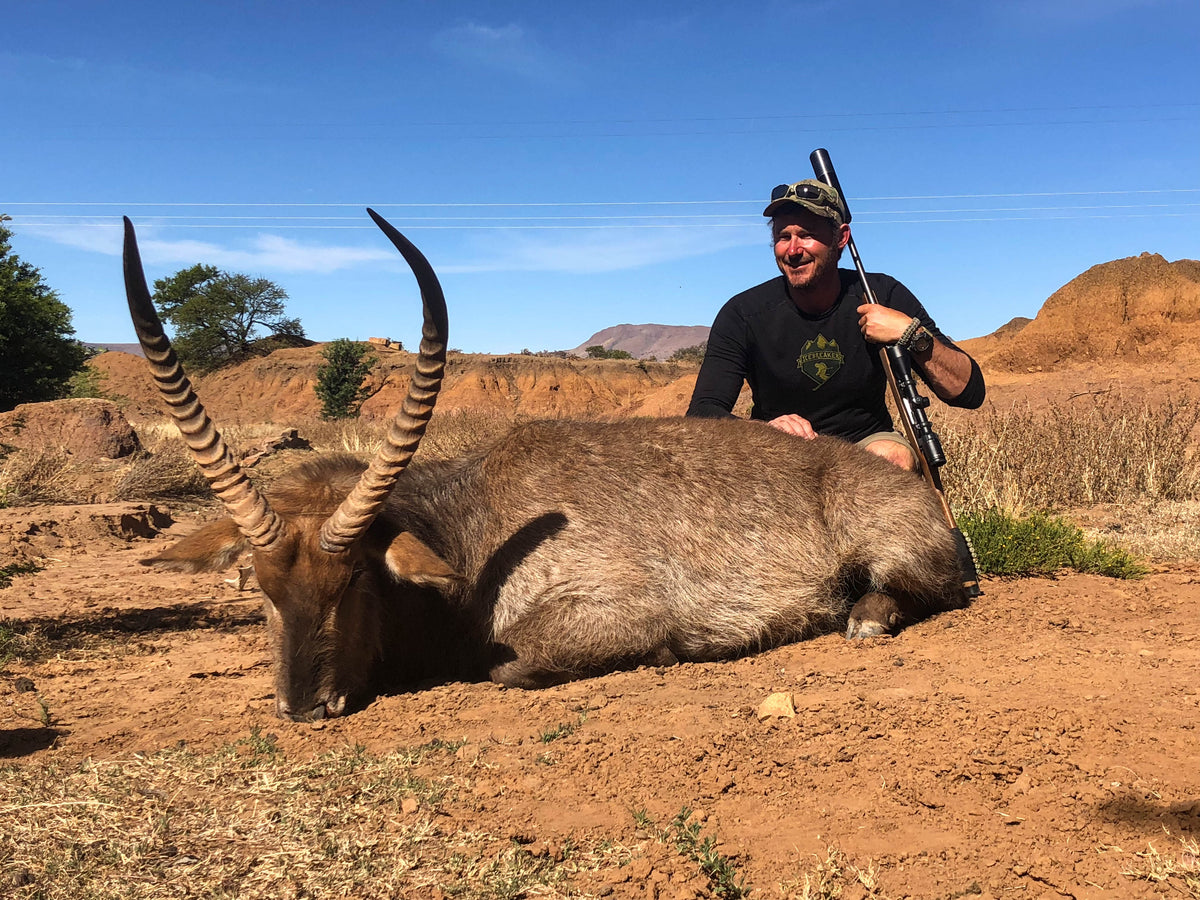
The waterbuck were found in the more broken country, close to the green strips of bush that followed the gullies. One great bull lay between the sculpted walls of a deep donga, its long ridged horns reaching above the eroded clay. Another was recovered upon open ground with the red ravines and thorn woodland behind it.
The rifles were fitted with sound moderators and used from tall tripod shooting sticks when the ground offered no natural rest. From the ridgelines, the scope looked out across miles of thornveld, dry gullies and flat-topped mountains.
Then there was another warthog.
This time, the bow did its work.
After the lost animal at the watering hole, there was particular satisfaction in finally kneeling beside a recovered warthog with the compound bow lying across it. The great curved tusks, coarse grey hair and battered face belonged to an animal built for hard country.
The first warthog had escaped us.
The second did not.
That is hunting too.

Rock Hoppers
That evening, the drinks began again.
We sat in canvas chairs upon the high ground, cold Castle lagers in our hands, watching the last light withdraw across the valley. The stone hearth burned beside us while the distant mountains darkened into silhouettes.
Just before we had consumed too much, Bruce suggested one final African diversion.
The game was called Rock Hopper.
It consisted of driving around the homestead paddocks after dark, armed to the teeth, in search of dassies. They are often called rock rabbits, although they are properly known as rock hyraxes.
They appeared among the rocks after dark, and the object was straightforward enough.
Find them. Light them. Shoot them.
Only in Africa could pest control become the evening’s entertainment.
Afterwards, we returned to the fire and resumed the important business of drinking.
The stone fireplace burned hot, but the real spectacle came from the great bonfire beyond it. Whole limbs of wood were stacked together and set alight, the flames rising high into the night and illuminating the surrounding trees.
There had been clean kills and there had been imperfect shots. There had been success, disappointment and game that escaped.
That is hunting.
Best intentions, experience and careful preparation improve the odds, but they do not guarantee a perfect conclusion every time.
There had been a lost warthog and another recovered. There had been blue and black wildebeest, springbok, gemsbok, waterbuck and red hartebeest. There had been two magnificent kudu bulls that had ran away untouched.
There had been poachers, trackers, parched grass, iron-red earth, muddy water, fickle winds and enough meat to feed a great many people.
Most importantly, there had been friendship.
Five men had travelled from opposite sides of the world to meet beneath an African sky. We had hunted together, eaten together and laughed until the bottles were empty and the fire had collapsed into glowing red coals.
Those are the moments that remain when the trophies, photographs and numbers begin to fade.
The smell of meat over the braai.
The taste of cold Amarula.
The crackle of the fire.
Old friends telling familiar stories beneath an impossible spread of stars.
Africa gets beneath the skin. The connection is ancient, deep and visceral. You do not merely see it.
You feel it.
TIA.
This Is Africa.
Wherever your next adventure takes you, remember there’s always a place for you around our campfire. Until next time.



Leave a comment
This site is protected by hCaptcha and the hCaptcha Privacy Policy and Terms of Service apply.