
SOUTHERN ALPS | CHAMOIS COUNTRY
Pull up a chair. The fire's warm, and you're in good company.
There are few places left where you can disappear completely.
The Southern Alps are one of them.
Once the helicopter lifts away, there are no roads, no phone reception and no easy way home. The mountains don't care who you are or how experienced you think you might be. They simply carry on as they always have, indifferent to the small lives passing briefly through them.
That's one of the reasons I keep returning.
Robin and I had talked about this trip for months. Maps were unfolded, weather forecasts studied and gear checked and rechecked until there was little left to do except commit. We hoped to find a good chamois, but the truth is we'd have gone anyway. A few days living beneath canvas in the Southern Alps needs very little justification.
By mid-afternoon we were standing beside the helicopter near Haast, watching our gear disappear into the cargo basket.
Our packs.
The rifles.
A traditional canvas wall tent.
A small tent stove.
A diesel heater.
Five days' worth of food.
One thing we've learnt over the years is that if a helicopter is carrying your camp into the mountains, there is no reason to eat badly. Good coffee, thick steaks, bacon, fresh bread and decent meals weigh very little compared with the memories they create at the end of a long day. Some things are worth carrying.
The engine note deepened and the machine lifted smoothly from the ground.
Within minutes the road had disappeared behind us.
The flight inland is almost overwhelming the first time you experience it. Valleys unfold one after another, braided rivers twist through grey shingle far below and waterfalls tumble from hanging basins that seem almost impossible to reach on foot.
The further we flew, the smaller the world we had left behind became.
A mere ten minutes later the pilot banked gently into a broad alpine basin surrounded by steep scree slopes, snow-covered peaks and endless golden tussock. Rotor wash flattened the grass around us before the skids settled onto the ground.
For a few minutes everything was movement.
Gear unloaded.
Quick handshakes.
A final check that nothing had been left behind.
Then the pilot climbed back into the cockpit.
The blades gathered speed.
The helicopter lifted away.
Robin and I stood quietly, watching it climb out of the basin until it disappeared beyond the ridge.
The sound lingered for another minute before fading altogether.
It is a strange feeling.
One moment you're surrounded by machinery and conversation.
The next, there is nothing but wind, mountains and the knowledge that you're entirely on your own.
"Well," Robin said with a grin.
"We'd better make ourselves at home."
Camp always comes first.
The tent took shape surprisingly quickly, each guy rope carefully tensioned against the stony ground before we carried everything inside. Sleeping bags were unrolled, the little stove assembled and the diesel heater tucked into its corner. Outside we built a simple fire pit from flat stones gathered nearby and stacked enough firewood to see us through several evenings.
By late afternoon camp had settled into itself.

There is something deeply satisfying about a well-organised camp. Every item has its place. Wet gear stays separate from dry. Food is close at hand. Boots wait outside the door. Small routines establish themselves almost without discussion.
They would become far more important than we realised.
With everything finished we wandered up a nearby rise overlooking the basin.
From above, our camp looked almost insignificant.
One small canvas tent sitting alone in an immense landscape of rock, snow and tussock.
It struck me how easily the mountains reduce your sense of importance.
Out here there are no deadlines.
No emails.
No traffic.
No endless background noise demanding your attention.
Only weather.
Light.
Distance.
And time.
As evening settled over the basin we cooked our first meal over the fire, talking about the country we'd explore in the morning and the faces that looked most promising for chamois. The air grew colder once the sun dipped towards the horizon where sea meets sky, and before long we retreated inside the tent where the little stove quietly chased the chill from the canvas walls.
Outside, the mountains disappeared into darkness.
Tomorrow we'd start hunting.
As we shared a fine single malt neither of us knew that within forty-eight hours we'd be sitting inside this same tent listening to a southerly storm try its hardest to tear it from the mountain.

------------------------------------------------------------------------
The first morning in the mountains always begins the same way.
Not with an alarm, but with anticipation.
Long before daylight reached the basin I was awake, lying quietly in my sleeping bag, listening to the silence beyond the canvas. The little stove had long since lost its flame and the air inside the tent had that sharp alpine chill that makes climbing out of a warm sleeping bag a genuine test of character.
Robin was already awake.
"You awake?" I asked.
"Yup." Came the monosyllabic response
I wasn't surprised.
There are some mornings sleep simply gives up.
Outside, the world was still black. But the last embers still glowed so I rekindled the fire and the light was quickly followed by the warmth.
A scattering of stars hung above the basin and every breath drifted into the beam of my headtorch before disappearing into the darkness. Somewhere beyond camp a river whispered through the valley, but otherwise the mountains were completely still.
Coffee came first.
It always does.
There is something deeply satisfying about holding a hot mug while the world slowly wakes around you. We cooked breakfast without saying much, content to watch the eastern sky change from black to deep blue before the first sunlight touched the highest peaks above us.
Within minutes the mountains began to transform.
Grey rock became silver.
Silver became gold.
Shadows retreated down the faces while the basin below remained wrapped in the cool blue light of dawn.
It is impossible to grow tired of watching day arrive in the high country.
We packed quietly, checked our gear one final time and left camp behind.
The climb out of the basin was steady rather than difficult, winding through alpine tussock before giving way to broken scree and scattered bluffs. Every hundred metres or so we'd stop, partly to glass ahead and partly because the country deserved more than simply marching through it.
The tent quickly became a tiny speck far below us.
Soon it disappeared altogether.
As the morning warmed, the mountains began to feel alive.
A pair of falcons worked the valley below, riding invisible currents along the cliffs before disappearing beyond a ridge. Higher up, a lone kea landed on a rock no more than twenty metres away and regarded us with the sort of curiosity only a kea can manage.
He hopped closer.
Tilted his head.
Looked at Robin.
Then at me.
Then at the buckles on my pack as though deciding whether they belonged to him instead.
We stood perfectly still.
There was no reason to interrupt the moment.
After a minute or two he gave a loud, rasping call, spread his wings and drifted effortlessly into the valley, banking away until he disappeared against the dark rock beyond.

Neither of us spoke.
Some moments don't need commentary.
We continued climbing.
------------------------------------------------------------------------
By mid-morning we'd covered several kilometres, stopping often to study distant faces through binoculars. Most of what caught our attention turned out to be nothing more than pale rocks or patches of lingering snow. That's mountain hunting. Patience isn't just useful; it's essential.
It was close to late morning when Robin stopped so suddenly I nearly walked into him.
He raised his binoculars but said nothing.
After a few seconds he pointed.
"There."
I followed his finger across the basin.
At first I couldn't see anything.
Then it moved.
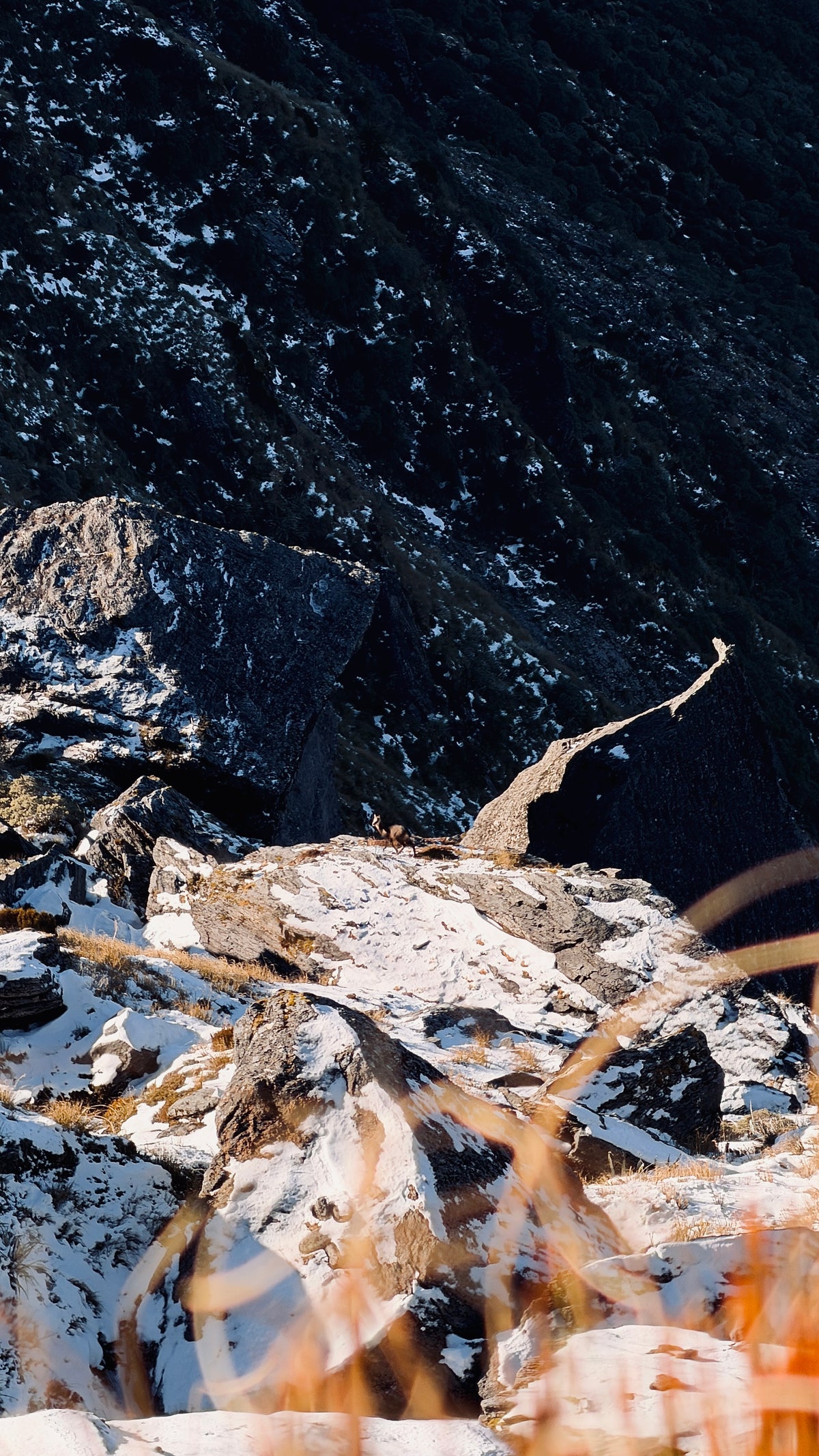
A solitary chamois was feeding across a steep scree face, almost invisible against the shattered rock. Without movement we'd never have found it.
For several minutes we watched quietly.
There was no rush.
The animal wasn't going anywhere, and neither were we.
Eventually Robin lowered his binoculars.
"I think we can get around beneath him."
I studied the country between us.
It wasn't going to be easy.
From where we stood it meant dropping into the basin, crossing a snow-fed creek and climbing back onto the opposite face without ever letting the chamois see us.
"I think you're right."
Without another word we turned and began the long stalk.
Mountain hunting has a way of making simple distances complicated.
What had looked like a straightforward approach from across the valley became a maze of loose scree, rocky bluffs and steep gullies. Progress was measured in careful footsteps rather than metres. Every loose stone had the potential to betray us.
The wind, thankfully, remained in our favour.
Cold air drifted steadily down the mountain into our faces, carrying with it the clean scent of snow and damp rock.
Every few minutes we'd ease ourselves high enough to check the animal's position.
Still feeding.
Still unaware.
Eventually we reached the last fold in the terrain.

Beyond it there was nowhere left to hide.
Robin slipped off his pack and quietly settled in behind his rifle while I stayed back, watching through my binoculars.
The chamois fed calmly across the slope before disappearing briefly behind a patch of broken rock.
Robin relaxed.
No point forcing the shot.
A minute later it stepped back into the open.
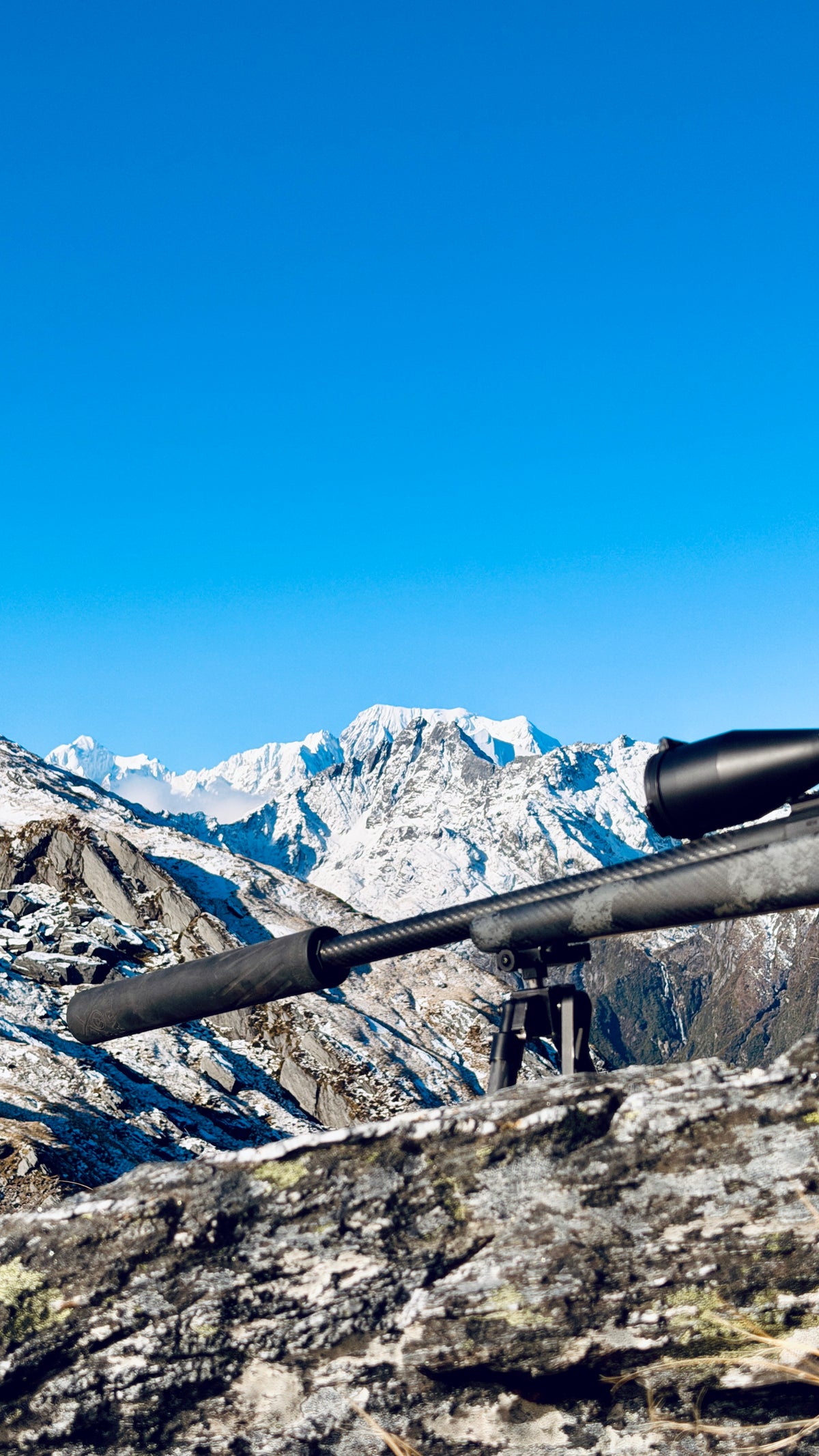
He settled the rifle once more.
The basin fell completely still.
Then the shot broke the silence.
The sound rolled away through the surrounding valleys before fading into the distance.
Through the binoculars I saw the buck stumble before disappearing from sight.
Robin looked back over his shoulder.
Neither of us needed to say anything.
The climb across confirmed what we'd already hoped.
It was a fine mature buck.
We spent a quiet moment beside the animal before beginning the careful work that follows every successful hunt. There was no celebration, no triumphant shouting and no photographs taken in haste. Moments like these deserve a little respect.
By the time we shouldered our packs again, the afternoon sun was warming the basin below.
The walk back to camp felt lighter than it should have.
Not because the packs weighed less.
Because the day had unfolded exactly as we'd hoped.
Back at camp we cooked a proper meal, poured another mug of coffee and watched the evening settle gently across the mountains.
The basin was calm.
The sky was clear.
It was difficult to imagine it being any other way.
The first distant rumble of thunder the following afternoon would prove just how quickly the Southern Alps can change.
------------------------------------------------------------------------
The following morning dawned much like the first.
Cold.
Still.
Clear enough to make us wonder whether we'd been fortunate enough to strike a perfect run of weather.
We spent the morning wandering further up the valley, glassing distant faces and exploring country we'd admired from camp the evening before. There were no opportunities worth pursuing, but that hardly mattered. We'd already achieved what we'd come for, we found ourselves stopping more often simply to admire the country around us.
By early afternoon we were back in camp.
Lunch had given way to coffee, and we were sitting outside enjoying the warmth of the sun when I heard the first rumble.
It was so distant I wasn't even sure it was thunder.
Robin looked up.
"You hear that?"
I nodded.
"A long way off."
We went back to our coffee.
The sky above us was still mostly blue, broken only by scattered cloud drifting lazily across the peaks. There was nothing to suggest what was about to arrive.
Ten minutes later I noticed the wind.
Not where we were.
Across the basin.
A broad sweep of golden tussock suddenly flattened on the opposite mountainside before slowly climbing towards us, as though an invisible hand were brushing across the landscape.
Behind it came cloud.
Not the soft afternoon cloud we'd watched all morning, but a solid wall of dark grey pushing hard over the western ranges.

It was moving astonishingly fast.
"We'd better secure camp."
There was no panic.
Not yet.
We tightened a few guy ropes, packed away anything that might blow around and moved the remaining firewood beneath cover.
The temperature had already begun to fall.
By the time we'd finished, the basin had changed completely.
The sunlight had vanished.
It couldn't have been much after three o'clock, but it looked closer to evening. The mountains that had glowed in the sunshine only an hour earlier had disappeared behind a curtain of low cloud.
The first drops landed heavily on the canvas roof.
Then another.
Then a dozen more.
Within minutes rain was hammering the tent hard enough that conversation became difficult.
The lightning was still some distance away.
The flash would come first.
Then, five or six seconds later, the thunder would roll across the valley.
Each time it arrived a little sooner.
Five seconds.
Then four.
Then three.
We stopped counting after that.
Eventually the flash and the crack became almost one violent explosion directly overhead. The thunder didn't simply echo through the mountains—it seemed to explode inside them, rolling from ridge to ridge until the whole basin vibrated beneath it.
The wind arrived with astonishing force.
The canvas snapped so violently it sounded like heavy sailcloth in a gale. Every guy rope sang under tension. The poles bent alarmingly before springing upright again as each gust passed.
Neither of us said what we were both thinking.
We were wondering whether the tent would hold.
Leaving the tent became an exercise in timing.
Whenever there was the slightest lull, one of us would pull on soaked boots, wrestle into a rain jacket and dash outside with a headtorch to check the guy ropes before the next blast arrived.
Every peg was checked.
Every knot retightened.
Then we'd throw ourselves back inside, dripping water over the floor we'd spent the previous hour trying to keep dry.
The first leak appeared above my sleeping bag.
One cold drop landed squarely on my face.
Then another.
By evening there were several more.
Cooking pots and frying pans gradually found new jobs, scattered around the tent beneath the steady drips. Every so often one would fill and have to be emptied outside before returning to catch the next slow leak.
It became almost routine.
The little tent stove glowed warmly when we lit it, and the diesel heater was worth its weight in gold, but fuel was limited. We hadn't carried it into the mountains to waste it. We'd warm the tent, dry what clothing we could, then let the fire die before lighting it again only when it was genuinely needed.
Comfort became something to be managed rather than expected.
One thing we never compromised on was food.
A storm has a remarkable way of shrinking your world until the next meal becomes the highlight of the day. We cooked properly every time, filling the tent with the smell of bacon, steak and fresh coffee while rain lashed the canvas only centimetres away.
Those meals did more for morale than any heater ever could.
There was laughter.
There was plenty of swearing too.
Mostly directed at the weather.
Occasionally at another new leak we'd somehow failed to notice.
Time became strangely difficult to judge.
The days blurred together into a pattern of tightening guy ropes, emptying pans, drying gloves, brewing coffee and listening to the endless roar of wind outside the canvas.
There wasn't much hunting to be done.
Our world had shrunk to a patch of canvas no bigger than a small room.
Sometime during the second night, though neither of us heard it happen, the storm finally moved on.
The wind stopped.
The rain ceased.
For the first time in two days, the mountains fell completely silent.
------------------------------------------------------------------------
I woke without knowing why.
For the first time in two days there was no rain drumming on the canvas.
No wind pressing against the tent walls.
No guy ropes humming under strain.
Just silence.
Real silence.
For a few moments I lay there listening, almost suspicious of it.
Then I unzipped the tent door.
Cold alpine air poured inside.
The basin we'd gone to sleep in had disappeared.
In its place was an entirely different world.
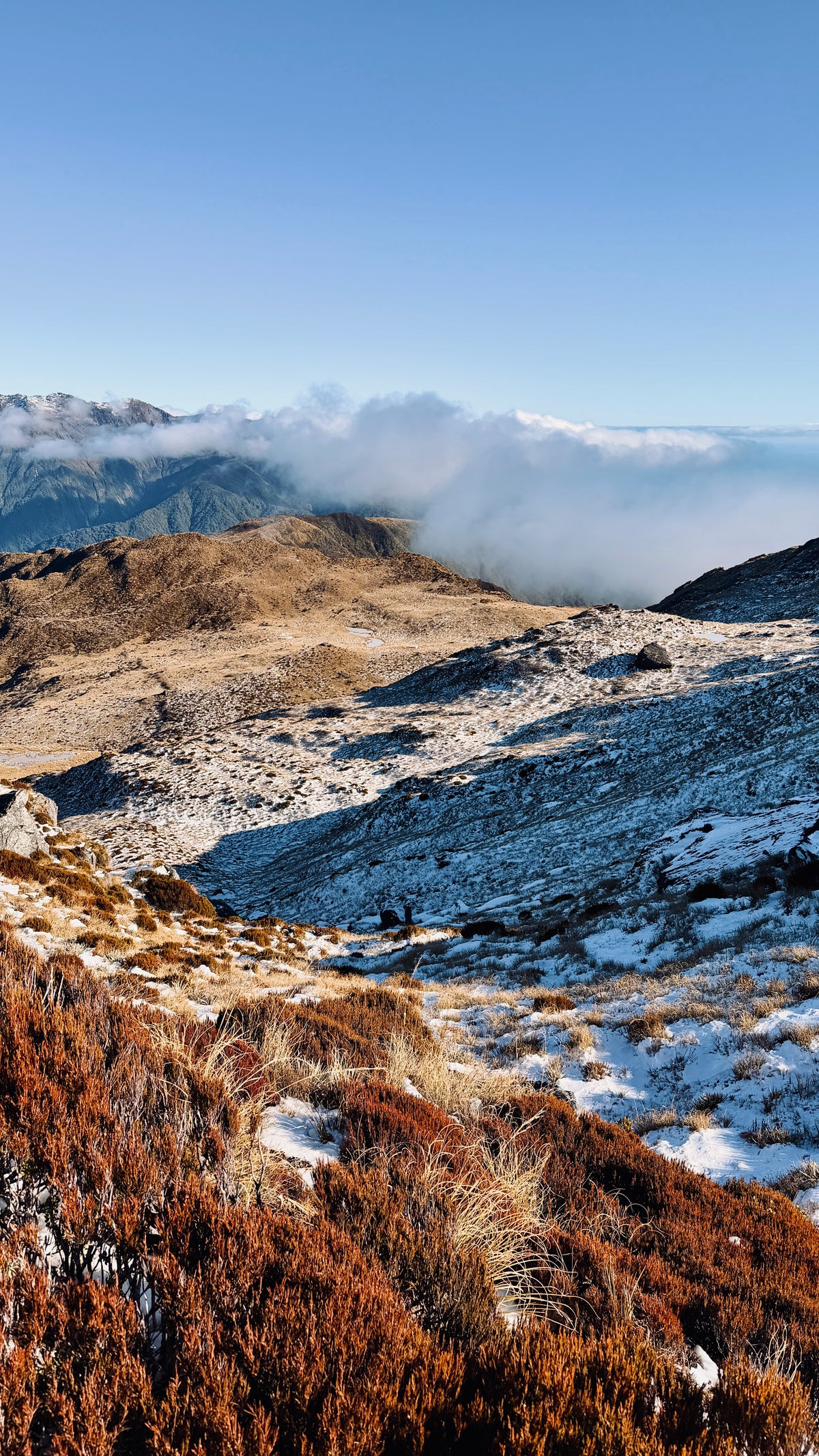
The mountains wore a fresh coat of snow. Every blade of tussock sparkled beneath a heavy frost, and the pools left by two days of relentless rain had frozen hard overnight. Above us stretched a sky so impossibly blue it was difficult to believe the violence we'd lived through only hours before.
Steam drifted lazily from our mugs as Robin joined me outside.
Neither of us spoke for a while.
There wasn't much to say.
The mountains had simply turned another page.
Breakfast took a little longer that morning.
Not because we weren't in any hurry, but because neither of us wanted to waste a morning like that. The warmth of the coffee felt better than ever, and the smell of bacon drifting across the basin somehow seemed richer in the cold, still air.
The little tent that had felt so vulnerable the night before now stood quietly in the sunshine as though nothing had happened.
Looking at it in the morning light, it was hard to believe we'd genuinely wondered whether it would still be standing.
It had done exactly what we'd asked of it.
It had given us shelter.
Once camp had dried in the sun we packed a small day pack and wandered back into the hills, not because we expected to find another animal, but because it seemed a shame to leave such a magnificent day unexplored.
Fresh snow had transformed the higher country.
Every ridge looked sharper.
Every shadow deeper.
The air carried that extraordinary clarity that only seems to arrive after a storm has scrubbed every trace of dust from the sky.
We climbed without any real destination.
Sometimes that's the best way to explore.
Without the pressure of hunting we found ourselves stopping more often.
Looking back towards camp.
Watching clouds form over distant peaks.
Following the tracks of animals that had continued their lives while we'd spent two days hidden beneath canvas.
The mountains had carried on exactly as they always do.
We were the only ones whose plans had changed.
By early afternoon we made our way back to camp and began packing for the flight home.
Sleeping bags disappeared into dry bags.
The stove cooled for the last time.
The final mugs of coffee were finished while we waited for the unmistakable sound of rotor blades somewhere beyond the valley.
Long before we saw the helicopter we heard it.
A faint mechanical thump echoing between the mountains.
Minute by minute it grew louder until the aircraft appeared over the ridge exactly where we'd watched the previous one disappear five days earlier.
Within minutes camp was reduced to neatly stacked bags waiting beneath spinning rotor blades.
The pilot climbed out smiling.
"Looks like you boys had a bit of weather."
Robin and I looked at each other and laughed.
"You could say that."
The flight out offered one last view across the basin.
From the air it looked peaceful.
Almost gentle.
There was nothing to suggest the thunder that had rolled through those valleys, the wind that had tried to flatten our little canvas home, or the hours spent tightening guy ropes by headtorch while rain found every weakness in the tent.
Mountains have a way of hiding yesterday.
Before long the basin disappeared behind us, swallowed once more by ridge after ridge of rock and snow until there was no sign we'd ever been there at all.
People often ask what makes a successful trip into the mountains.
Some think it's measured by trophies.
Others count the kilometres walked or the peaks climbed.
I've never been convinced.
Robin came home with a fine chamois, and it will always remind him of this trip.
For me, though, the memories are different.
The sound of the helicopter fading into silence.
A curious kea inspecting our packs.
Coffee at first light while the mountains woke around us.
Watching a storm march across the basin until afternoon became night.
The crack of thunder directly overhead.
The quiet satisfaction of sharing good food in a canvas tent while the weather did its best to drive us home.
And then waking to a world washed clean.
Adventure isn't always found in the moments we plan for.
Quite often it's waiting in the ones we never saw coming.
Wherever your next adventure takes you, remember there's always a place for you around our campfire.
Until next time.


Leave a comment
This site is protected by hCaptcha and the hCaptcha Privacy Policy and Terms of Service apply.